
Why Location Shoots Keep Failing MLR Review, And What Pharma Agencies Are Doing About It

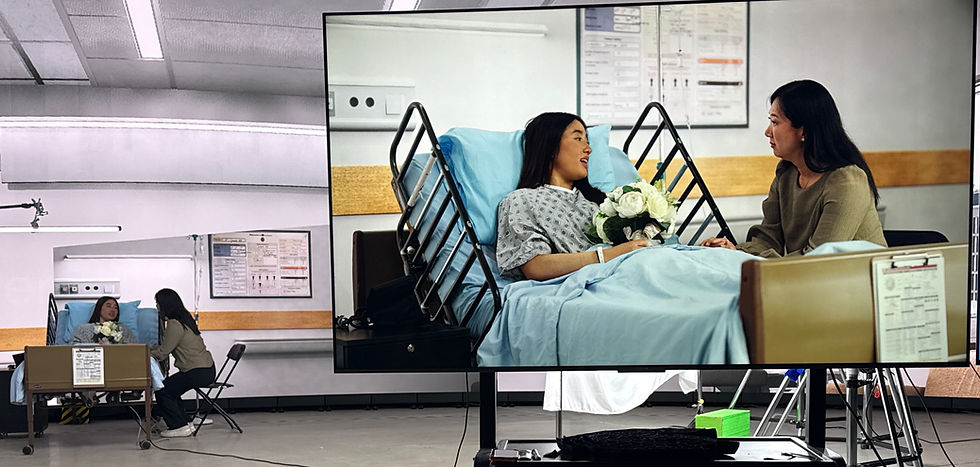
Week 2 of 4 · We Built A Hospital · XCrazy Studios
The approval cycle isn't the problem. The shoot is.
Most pharma agencies treat MLR review as a post-production problem. Submit the cut, wait for notes, revise, resubmit. Repeat until legal signs off.
But the agencies burning 2–6 extra weeks per project aren't failing in the edit suite. They were failing on set, weeks earlier, they just didn't know it at the time.
The Four Ways a Location Shoot Breaks MLR
1. Wrong compliance signage in the background
A hospital corridor. A pharmacy counter. A clinical consultation room. Every one of these environments carries signage — and in a real location, that signage is not yours to control. Formulary posters. Drug brand displays. Outdated safety notices. Competitor product placements.
Your crew doesn't catch it on the day. Your editor doesn't catch it in the rough cut. MLR catches it in review, and now you need a reshoot, or at least some unbudgeted paint fixes.
2. Inconsistent lighting between shoot days
Location shoots rarely wrap in a single day. Split days, second unit pickups, insert shots happen days or weeks apart. Natural light shifts or practical fixtures get changed by the facility and now the color temperature in the consultation room on Day 1 doesn't match Day 3.
MLR reviewers aren't cinematographers, but they notice when a scene feels discontinuous. The fix requires going back to the location — which may no longer be available.
3. Uncontrolled background talent
Real locations mean real people: Hospital staff in the background, patients in the corridor or a pharmacist who wasn't in the original release form. One uncleared face in a single frame triggers a legal hold on the entire sequence.
You can blur. You can reframe. But if the foreground performance is locked and the background isn't clearable, you're back on location.
4. The location isn't available for the reshoot
This is the one that kills timelines. You've identified the fix. You know exactly what you need. And the hospital won't let you back in — scheduling conflict, facility policy change, new administration, liability review.
You're not just reshooting. You're location scouting again.

What the Approval Cycle Is Actually Measuring
MLR review is a compliance gate. It exists to catch wrong claims, uncleared talent, uncontrolled environments, inconsistent presentation.
When a location shoot fails MLR, it's not bad luck. It's the review process working correctly. The environment wasn't controlled, the variables weren't locked and the production design didn't account for compliance requirements before the camera rolled.
The agencies shortening their approval cycles aren't getting better at revisions, they have a process to eliminate the failure points before the shoot begins.
The Controlled Environment Difference
A purpose-built virtual production environment changes the compliance equation at the production design stage — not the post-production stage.
Signage is designed in — and pre-cleared. Every background element is placed intentionally. Formulary posters, wayfinding, clinical notices — reviewed and approved before the first frame is shot. Nothing appears in the background that wasn't put there deliberately.
MLR sees a background built for compliance. There is nothing to flag.
Lighting doesn't drift. Ever. LED volume environments are programmable. The exact lighting state from Day 1 — color temperature, intensity, directionality — is recalled perfectly on Day 3, Day 10, or six weeks later for a pickup.
The discontinuity note never appears in your review cycle. Because the discontinuity never happened.
Every face on set is cleared before camera rolls. Cast, contracted, released. No incidental faces. No facility staff walking through frame. No liability exposure from a background extra who didn't sign a form. The legal hold never gets triggered. The sequence never goes on ice.
The environment doesn't have a calendar conflict. No facility scheduling. No new administration. No liability review from a hospital board. The set is bookable, repeatable, and ready — on your timeline. When you need a pickup, you book a half-day. You don't start over.
Compliance review happens before camera rolls — not after. This is the structural difference. On a location shoot, MLR reviews the finished cut — after every variable is already baked in. In a controlled VP environment, every background element, every lighting state, every talent release is locked before the first shot is taken.
You're not submitting a cut and hoping it passes. You're submitting a shoot that was designed to pass.
That's not just a faster approval cycle. That's a different kind of production altogether.
The Math
One MLR failure adds 2 weeks minimum. Two failures, which is not unusual on a complex campaign can add 4–8 weeks. On a project with a hard launch date, that's not a production problem, it's a business problem.
The agencies moving fastest through MLR aren't submitting better cuts. They're submitting shoots where every compliance variable was resolved before camera rolled.
That's a production design decision. And it starts before you book a location.

Comments