
We Built A Hospital: 14 Setups, 53 Takes, in 10 Hours.

Updated: Jun 1
A Real Hospital Would Have Given Us 6-8 Setups in a day max. We Got 14.
Fourteen setups, Fifty-three takes in Ten hours.
We built a hospital and then we shot in it, and because we built it in Unreal Engine, we had complete control over everything about it. Here's the full story:
This wasn't the first time we'd shot in this environment. The hospital had been used across a couple of vertical drama productions, which is always short-form narrative work with tight schedules, close coverage, trying to shoot 15 pages a day. Each shoot added to our understanding of how the assets came together, which configurations worked for different scene types, and where the environment needed full three-dimensional depth versus where a simpler solution like photographic or generated plates were enough.
By the time this shoot was scheduled, the groundwork was already done. We had established a discreet asset library for this environment, and pre-production was able to start from a position of knowledge rather than discovery.
Part 1: Before We Shot a Frame
What an Environment Actually Is
Most people hear "virtual production" and picture a green screen with better technology. That's not what this is.
An environment isn't a set, it's a library of assets for a location that allows you to build sets in virtual space. The hospital we shot in isn't one room, it's a configurable collection of walls, windows, corridors, fixtures, architectural details, lighting elements, and surface treatments. Every component of a hospital environment, available to assemble into any configuration a brief requires, in Unreal Engine. A patient room, corridor, an ICU bay, a surgery, doctor’s office or a nurses' station all can be built and iterated from the same set of assets. You're not locked into one layout. You're working from a library of assets that continue to be optimized for every shoot.
We built that library from the ground up, starting with a single unit, the hospital bed. Our hospital bed base unit was a bed, a side table, the machines around it, a visitor's chair, a curtain. Once that unit was approved and the scale was right, we iterated variations of it, different configurations giving some variability to the eye, so it’s not a repeated wallpaper pattern, but still retains the dimensions and scale of the original block, which gave us the randomness a real ward has, without having to lay out every room from scratch each time.


And from there the library grew outward. Nurses' stations, corridors, the doors connecting rooms to corridors followed the scale of the bed unit, and it all fit together on a modular grid perfectly alongside each other. Any door could connect to any corridor and any corridor could connect to any room. The environment could be assembled quickly in our blocking session, reconfigured between setups, and extended as new briefs required it.
We developed this approach specifically for vertical drama, where schedules are tight, setups are fast, and the environment needs to deploy into scenes immediately without a full layout from scratch every time. That distinction matters more than anything else in this piece, because a library built this way gets faster and richer every time you use it. We were building on a foundation, not pouring one new every time.
The Blocking Session
In our initial blocking session with the client DP, Production Designer and Director, before a single asset was placed or a single layout was discussed, we ask two questions:
What is the lens? & How is the camera moving?
Those two questions define everything that needs to exist in the frame, and they define exactly how developed and refined the assets need to be. If the camera is moving through the environment, tracking, pushing, circling, you need fully resolved three-dimensional assets. The movement and parallax will expose every flat surface. The depth will be tested from every angle. The environment needs to hold up from anywhere the lens lands.
If the camera is locked with a clean single, a static two-shot, or a product placement frame, a flat matte painting-style image will do the job perfectly without the need to build geometry that will never be seen from a second angle. No wasted asset development and no prep time spent on depth that never makes it into the frame.
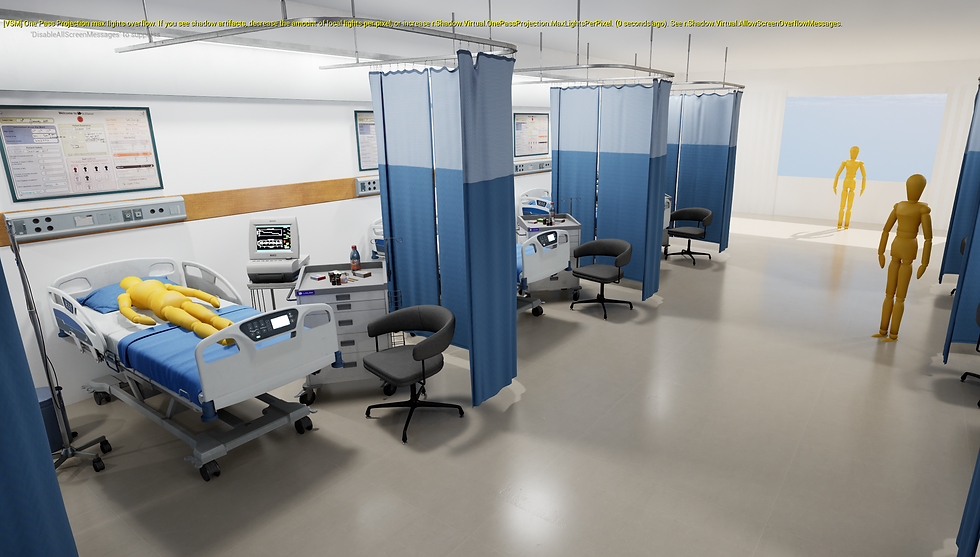
The two questions don't just define what the lens sees. They define what the asset is, what needs to be built, how fully it needs to be realized, and what can be left at a lower level of optimization without anyone ever seeing it.
That's where the pre-production efficiency lives. Not in working faster, but in building only what the storyboards actually require and nothing more. You're not building a hospital, you're dressing the set for exactly exactly what the lens will capture.
Pre-production for this shoot started with an online collaborative session between the DP, the production designer, and the XCrazy Virtual Art Department (VAD) operator, Mikey Rocha, working directly inside Unreal Engine together.
Not approximating a location or referencing images of a real hospital and hoping the day matches, but starting work in the actual environment that you’ll be shooting in. You can make decisions about what the camera will see before anyone has even stepped on stage.
"A prime objective of the build was to create the environments in a way that is easily configurable for different needs. When you’re on set and the director or DP wants to make a change to the virtual environment, it is absolutely paramount to be able to make those adjustments quickly while still keeping a high level of quality. This is why it’s so important when building these environments that everything is well organized and prepped for change."- Mikey Rocha, XCrazy VAD Artist.
Part 2: How the Day Moved
Setup 1 Through 14
The call was early, and we had lit the stage the day before. The first thing worth noting is at the top of the day a general lighting state was set for the working environment that was balanced and clean. And then we didn’t have to really touch the lights again that day, because we can more easily move the virtual world around the camera and lights.
On a real hospital location, every setup change could trigger a lighting reset. The gaffer, grip, electric moves eat up time on set. You may not have prepared for this, so the schedule starts to compress. And so by setup four you're already behind and looking for ways to triage the schedule to catch up.
Between setups, the environment was reconfigured around the camera. Between the front angle on the hospital bed, and the reverse showing the doctor at the foot of the bed, we swung the environment and the physical hospital bed around 180 degrees, and the camera stayed where it was to pick up this shot. The lights didn’t move.
Each reconfiguration took minutes, not hours. Each transition was already mapped from the blocking session, so the crew knew what was coming, and the schedule held.
By the time the day wrapped, we had fifty-three takes in the can. From a single stage, in a single day, without moving the camera department across a real building, without negotiating with a facilities manager, without losing an hour to a lighting reset that a real location can demand.
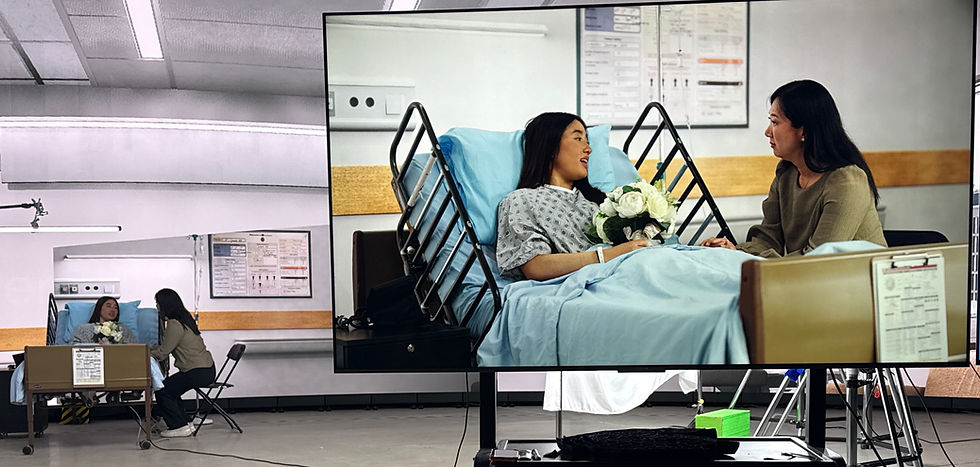
Part 3: The Numbers That Matter
14 setups. Environment reconfigurations, camera repositions, scene context shifts, all mapped in pre-production and all executed on the day without friction.
53 takes. We shot a take every 12 minutes on average. For a pharma or healthcare campaign that means coverage, options and the ability to get variants on each scene for different deliverables.
10 hours. Everything contained on one stage, under one day rate.
Zero location resets. The environment moved around the camera. Not the other way around.
That last point is the one that changes the conversation for every line producer who reads it. On a real location, the location is fixed and the production bends around it. Here, the production is fixed and the environment moves around it. That inversion is what made fourteen setups possible in ten hours.
Part 4: What This Means For Your Production
Every frame of this shoot was controllable, repeatable, and approvable before it was shot. The environment doesn't have a facilities manager or visiting hours, and it doesn't have a corner you can't dress because a real piece of medical equipment needs to stay there.
If Medical legal wants a different angle on the product shot, you can shoot it the same day. The client wants to see the corridor wider, you make it wider immediately and move on. The director wants to try the scene from the other end of the ward, you can flip it.
Closing: What the Day Proved
We didn't discover anything new on this shoot, we confirmed again what we already knew, that the work happens in pre-production, that the environment should serve the camera and not the other way around, and that complete control over every element of a set is not a luxury for a pharma or healthcare production. It's a requirement.
Fourteen setups. Fifty-three takes. Ten hours.
That's what complete control looks like.
📍 XCrazy Studios · New Jersey
Comments