
The Pharma Shoot Was Ready. Then Medical Affairs Walked On Set.

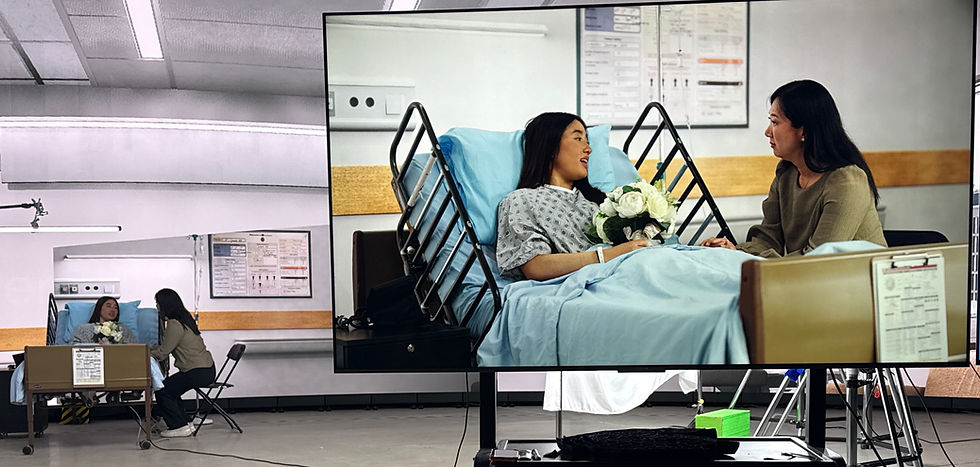
Week 1 of 4 · We Built A Hospital · XCrazy Studios
It's 7:14 AM. Crew is on the clock. Talent is in the green room. The brand manager flew in from Chicago.
Medical affairs walks onto the set, looks at the background wall, and points.
There's a poster. It was there when the location scout came through. It was there during the tech scout. Nobody flagged it. The indication language on it doesn't match the approved MLR brief. It's in the background of every shot in the hospital corridor sequence.
The art director is on the phone. The brand manager is doing the math.
The shoot was ready. The set wasn't.
The Gap Nobody Talks About
MLR gets all the attention in pharma production. Pre-production gets almost none.
The compliance brief existed. Everyone read it. The art director interpreted it correctly. The failure wasn't negligence — it was structural. There is a gap between a written compliance brief and a physical environment, and that gap doesn't close until someone walks on set.
Medication labels. Prop packaging. Dosage callouts. Indication language. Background signage. These are compliance surfaces. Every one of them needs to be reviewed against the brief. And in most pharma productions, that review happens at the worst possible moment — when the crew is already on the clock.
Location Makes It Worse
Shooting on location in a real hospital or clinic adds a layer of compliance exposure you cannot design out.
The environment was built for medicine, not for your brief. The signage on the walls, the posters in the corridor, the labels on the equipment in the background — none of it was placed there with your MLR submission in mind. You didn't put it there. You can't easily change it.
Location scouts don't read compliance briefs. Art directors can dress a location, but they can't gut it. On shoot morning you're negotiating with a facilities manager about whether a poster can come down — and half the time the answer is no, because it's a regulatory requirement of the facility itself.
Background signage in a real hospital corridor can invalidate a shot entirely. You won't know until someone reviews the frame. Sometimes that someone is medical affairs on set. Sometimes it's the MLR reviewer three weeks later.
Location gives you authenticity. It takes away control. In pharma production, control is the brief.
The Studio Set Doesn't Fully Solve It
Moving to a studio set solves the location problem. You built the environment. You own every surface.
But the compliance review still happens on shoot day.
The workflow is: art director interprets brief and builds the set, then medical affairs reviews in person when the crew is already on the clock. The physical set can't be iterated cheaply at 7 AM. Swapping a prop label is a patch. Repainting a background sign is a half-day. Rebuilding a section of dressing is a reschedule.
Studio solves location chaos. It doesn't solve the pre-production compliance gap. The compliance brief and the physical environment still exist in two separate worlds until shoot day. You've moved the problem. You haven't eliminated it.
What a Stop Actually Costs
A full-day stop gets the headlines. But you don't need to lose a day to feel it.
Medical affairs flags the poster at 7:14 AM. By 8:15 AM you have a patch — gaffer tape over the offending text, a replacement prop sourced from the kit bag, a background redress that's 80% of what the art director intended. You're back on the floor.
But that hour didn't disappear. It compressed everything that follows.
The corridor sequence that needed four setups now gets three. The coverage you wanted on the reverse angle gets cut. The dolly move gets replaced with a static because there's no time to lay track. The director makes the call — protect the hero shots, sacrifice the texture. The editor will figure it out.
And they do. Mostly.
The cut is tighter than it should be. The scene feels slightly airless. The brand manager notices but can't articulate why. The agency presents it anyway because the deadline didn't move.
That's not a production failure. That's a production compromise — the kind that doesn't show up in a post-mortem because technically the shoot delivered. Nobody writes a case study about the dolly move that didn't happen.
But the compliance surface that caused it? It was in the brief. It just never made it onto the set.
The VP Environment Closes the Gap
In a controlled virtual production environment, the set exists digitally before it exists physically.
Medical affairs reviews the environment in pre-production — not on shoot day. Medication labels, background posters, indication language, prop packaging — all of it is reviewable, all of it is changeable, before a single crew member is booked. The conversation that used to happen at 7:14 AM on the floor happens at 2 PM on a Tuesday three weeks earlier, in a browser window, with no clock running.
The art director doesn't patch. They fix. There's no crew standing by, no talent in the green room, no studio rate ticking. A flagged compliance surface gets corrected in the digital environment and locked before the physical shoot is ever scheduled. When medical affairs walks on set, they've already seen the set. They signed off on it. They're there to observe, not to intervene.
No facilities manager negotiation. No 7 AM patch jobs. No background signage you didn't put there. No compressed shot list. No dolly move that didn't happen.
The compliance brief and the physical environment are reconciled in pre-production — not as a hope, but as a confirmed step in the workflow. Art director, brand manager, and medical affairs are aligned on the same environment before the clock starts. MLR submission goes in with a set that has already been reviewed. Not hoped-reviewed. Actually reviewed.
And the environment doesn't disappear after the shoot. It's reusable. Same hospital set, next campaign, already compliance-cleared. The pre-production rigour you invested in the first shoot amortises across every shoot that follows. The dolly move you had to cut last time? It's in the shot list this time — because you're not spending the morning patching a poster.
When Does Medical Affairs See Your Set?
If your next hospital shoot has a compliance brief — and it does — there is one question worth asking in pre-production: When does medical affairs see the set?
On location: shoot day, if you're lucky. More likely, never — until someone flags a frame in post.
On a built studio set: shoot day, when everything is already committed.
In a VP controlled environment: pre-production. Before the clock starts. Before the brief and the environment have a chance to diverge.
We built the hospital. Medical affairs has already been in it.
Book a tour and see the environment before your next brief lands.
The shoot wasn't ready. The set was. Those are two different things.

Comments